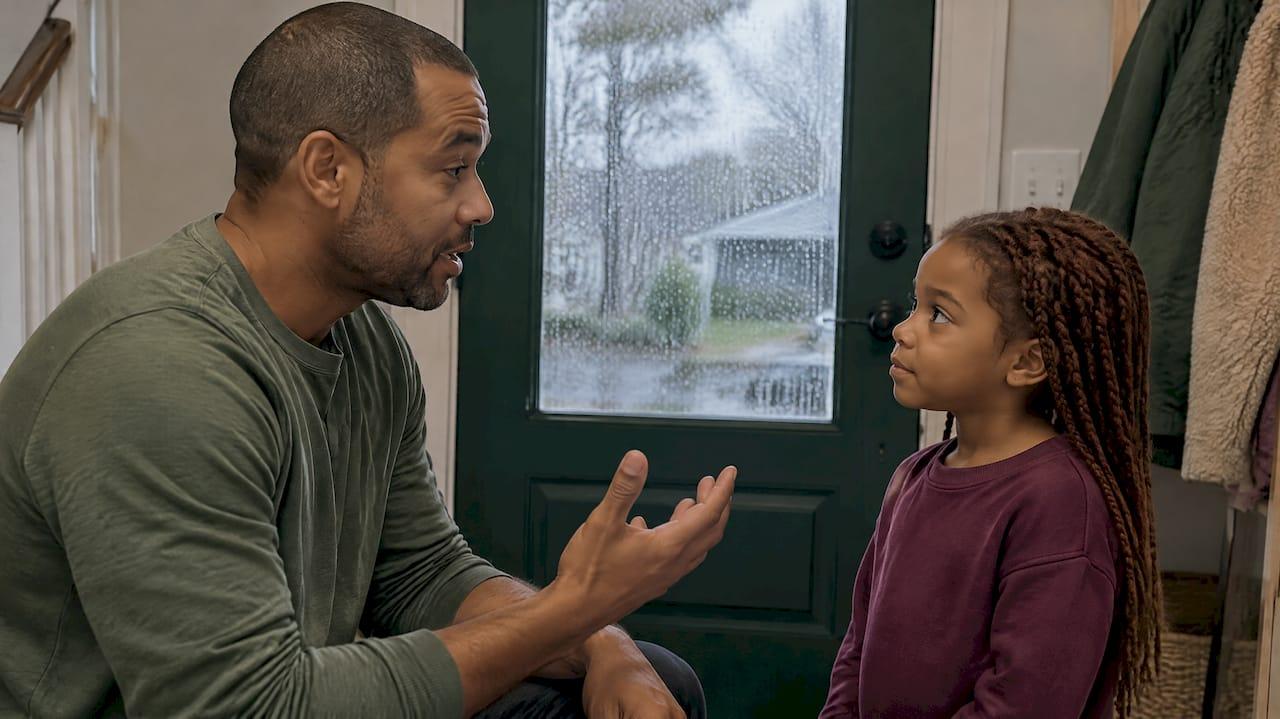
Tell a child that sarcasm is when someone says the opposite of what they mean, then show it with a clear clue. That is the whole method. Most children cannot use it until about age 5 or 6, and they usually do not find it funny until later. So for ages 3 to 8, the goal is to help them spot it and not feel tricked. The goal is not to make them fluent in it.
This guide gives you a kid-sized definition, examples that work, a step-by-step routine, and a way to talk about when sarcasm is playful and when it stings.
TL;DR
- Kid-sized definition: sarcasm is when someone says the opposite of what they mean, usually as a joke.
- Most children start to catch it at 5 or 6. Seeing why people use it often takes until 7 to 10.
- Teach it with concrete clues: the voice, the face and what actually happened.
- Practice with real moments and picture-book scenes, then mix in sincere statements so the child does not guess "sarcasm" every time.
- Talk about the feeling it leaves: laughing with someone is different from laughing at someone.
Table of Contents
- A definition a 5-year-old can hold
- When children can understand sarcasm
- Examples a young child can follow
- How to teach it, step by step
- Playful or hurtful: talking about the feeling
- Ideas for classrooms, libraries and counseling rooms
- Humor, books and why stories help
- Our perspective
- A way to practice at home
- FAQ
- Sources
A definition a 5-year-old can hold
Start with one sentence. A University of Calgary picture book for children puts it this way: sarcastic is when someone says the opposite of what they mean. Its example is a person saying "Great weather we're having!" while it is storming. The speaker says something they do not actually think, to be funny.
Adult dictionaries add one more layer. The Cambridge English Dictionary describes sarcasm as remarks that clearly mean the opposite of what they say, made to hurt someone's feelings or to criticize something in a humorous way. That "criticize" part is why sarcasm confuses children. The words are kind, but the message is not.
So give your child two short rules:
- The words say one thing. The speaker means the opposite.
- You find out by checking the clues: the voice, the face and what is really happening.
That is enough for a first lesson.
When children can understand sarcasm
Age matters more here than almost anywhere else in language teaching. If you explain too early, the child nods and learns nothing.
Researcher Penny Pexman writes in The Conversation that children probably do not begin to understand sarcasm until 5 or 6. Before that, they take the words literally. Once they grasp the reversal, they may decide the speaker is lying rather than teasing. Seeing sarcasm as intentional humor usually comes around ages 7 to 10.
A 2009 study in the Journal of Child Language found that 5- and 6-year-olds were starting to grasp the non-literal meaning of sarcastic speakers, but did not yet tell apart what the speakers intended. By ages 9 and 10, children were more accurate.
Here is what that looks like by age:
| Age | What you can usually expect | What to do |
|---|---|---|
| 3 to 4 | Takes words literally. | Keep speech sincere. Name a joke as a joke if you make one. |
| 5 to 6 | May see that the words are "backwards" but not why anyone would say them. | Teach the definition and the clues with simple examples. |
| 7 to 8 | Can hold two ideas at once, so the humor starts to make sense. | Talk about the speaker's purpose and how it feels to the listener. |
Why the gap? Pexman explains that sarcasm carries two meanings at once. The speaker is both critical and funny. Most children can only hold two conflicting ideas in mind around age seven. Spotting sarcasm at 5 or 6 therefore comes before enjoying it.
Pretend play is an early place where children practice the idea that something can mean more than it seems. The role of pretend play development in toddlers is worth a read if your child is on the younger end. A child who has played "this banana is a phone" has already met the idea that words and actions can stand for something else.

Why some children take longer
Children differ. Pexman notes that differences in children's experiences of sarcasm can affect how well they detect it. A child who rarely hears it will find it harder. A shy or sensitive child may also take it personally, because the words sound mean even when the speaker is joking. Go slower with these children and use more concrete clues.
If your child is autistic, or you are a counselor or therapist supporting a child who reads language literally, the same approach applies. Use concrete clues, short practice rounds and plenty of repetition. If you have a specific concern about your child's language development, a speech-language pathologist or your pediatrician is the right person to ask.
Examples a young child can follow
The best examples are ones where the child can see the proof. The sarcastic words clash with something visible.
The Calgary picture book uses scenes like these:
- A messy room, and someone says, "Wow. What a tidy room."
- A pizza splats on the floor, and Dad hears, "Smooth move, Dad."
- A traffic jam, and someone says, "Well, this is just great."
- Noisy tuba practice, and someone says, "SUCH BEAUTIFUL MUSIC!"
Notice the pattern. In each case you can point to the clue: the mess, the floor, the cars, the noise.
Some phrases are common enough that children pick them up early. Pexman notes that sayings like "Yeah, right" and "Thanks a lot" are sarcastic forms children tend to use first, around age four or five.
Home examples work well too:
- Your child spills juice. You say, with a flat voice, "Oh, perfect." Then explain: "That was sarcasm. It was not perfect. I meant the opposite."
- It is pouring rain on picnic day. "Lovely weather."
- Your child leaves all the peas on the plate. "Looks like you were really hungry."
Keep your own tone gentle. The target of the sarcasm should be the weather, the traffic or a dropped pizza, never your child.
How to teach it, step by step
This routine follows the logic of the research. A 2021 study of 111 five- and six-year-olds tested teaching children what sarcasm is and what cues to look for. The training improved their ability to detect sarcasm and to understand what the speaker believed and intended. It did not improve their understanding of why it is funny. That tells you what to aim for: recognition first, humor later.
Step 1: Pick a calm moment
Do not explain sarcasm right after you have said something sarcastic in a stressful moment. Choose a quiet time, such as a book on the couch. A child who feels confused or teased will not take in a definition.
Step 2: Give the one-sentence definition
"Sarcasm is when someone says the opposite of what they mean, often as a joke." Say it the same way each time. Ask your child to say it back in their own words.
Step 3: Show the clues
Point to three things:
- The voice. Sarcasm is often flat, slow or extra dramatic. Psychology Today describes it as usually delivered with a straight face, a flat voice and just enough exaggeration to signal the speaker is not serious.
- The face. An eye roll, a smirk or a raised eyebrow.
- The situation. Do the words match what you can see?
The situation clue is the strongest for young children. "Did the room look tidy? No? Then the words and the room do not match."
Step 4: Practice with a sarcastic voice, on purpose
The Calgary book suggests parents use a sarcastic voice where it fits and go off-script to talk about other examples. Try it as a game. Say a line in a plain voice, then in a sarcastic voice, and ask which one is which.
Step 5: Ask open questions
Instead of telling, ask. "What did I say?" "What did I mean?" "How do you know?" Praise correct answers. A child who can point to the clue has learned more than one who can only repeat your definition.
Step 6: Mix in sincere lines
Once your child gets it, add real compliments. "What a tidy room" after they cleaned it is not sarcasm. If every comment gets labeled sarcastic, the child learns to distrust kind words. Mix the two so they have to check the clues each time.
Step 7: Give them a script for confusion
Tell your child what to say when they are not sure. In the Calgary book, the main character says "Huh?" and asks her mom what sarcastic means. Later she asks her dad, "Are you being sarcastic?" Both are good lines to practice:
- "Huh?"
- "Are you joking?"
- "Did you mean the opposite?"
A child who knows they are allowed to ask feels safer than one who guesses.
Playful or hurtful: talking about the feeling
Once children can spot sarcasm, the next question is how it lands. A 5 or 6-year-old may see that the words are backwards without seeing the humor. Pexman explains that they do not yet see why the speaker would talk that way. Around age 9, children begin to find humor in teasing and sarcasm. So for most of ages 3 to 8, your conversation is about feelings, not comedy.
Try these questions:
- "Did that make you feel happy or sad?"
- "Was the person laughing with you or at you?"
- "Is the joke about a thing, like the weather, or about a person?"
Michigan State University's guide for parents of preschoolers says humor should make people feel happy and not bad about themselves. It also encourages teaching the difference between laughing with someone and laughing at someone. That is a good rule for the age group.
Here is a simple guide you can give your child:
- Playful: about a thing or a funny situation, said with a smile, and everyone laughs.
- Hurtful: aimed at a person, said with a frown or a sneer, and someone feels small.
- Not sure? Ask. "Are you joking?"
Psychology Today also notes that when sarcasm becomes someone's default way of talking, it can come off as bitter or guarded and wear down trust over time. That is a useful thing for adults to remember at home and in the classroom. Children copy the tone they hear.
Ideas for classrooms, libraries and counseling rooms
If you teach early grades, work in a library or see children in a counseling setting, the same steps apply in a group.
- Read aloud, then pause. Stop after a line that is sarcastic and ask, "Did the character mean that?"
- Use a clue chart. Three columns: voice, face, what happened.
- Keep a "Huh?" rule. Children may say "Huh?" or "Are you joking?" any time without being laughed at.
- Rehearse feelings, not just words. Pair the lesson with feelings activities. Our guide to feelings Pictionary for ages 3 to 8 works well for naming what a tone of voice feels like, and the low-prep book companion activities give you ways to follow a story with a short talk.
For a wider set of tools, see our pieces on storytelling for emotional learning and research-backed social stories for kids. Both fit the same pattern: a short story, a clear clue and a calm conversation afterward.
Humor, books and why stories help
Stories give children a safe distance. A character misreads a joke, feels confused and asks a question. The child watching learns the move without being the one who got teased.
That is also why humor belongs in a child's reading life. We have written about how humor in therapeutic children's books helps kids and why funny books make good gifts. If you are choosing a book to start a conversation, our list of gift books that spark conversation for ages 3 to 8 is a good place to start.
Our perspective
We write for children ages 3 to 8, and we think about sarcasm the same way we think about any big feeling: children need a name for it, a clue to spot it and a safe place to ask questions.
Our stories and decks aim to build emotional literacy without lecturing. We believe a child learns more from a character who says "Huh?" and gets a kind answer than from a rule on a page. Playful chaos and careful design can sit together: the humor draws the child in, and the clear emotions give them something to hold on to.
That is the idea behind our original characters and story worlds. They let a child see a confusing moment from the outside, talk about it and try again.
Derek Amarillas
A way to practice at home
Our Duckwave Decks are $7 each, a one-off price. They are themed card decks built around original characters, and they give you something to hold and talk over with your child. Use the cards as prompts for the questions in this guide: what the character said, what they meant and how it felt. You can see the decks at Icon Literary.

If you are choosing something for a classroom or library shelf, the catalog shows Socko's Universe. For a parent's view on what to pick as a gift, see our parent's guide to purposeful gift giving.
FAQ
What is the simplest way to explain sarcasm to a young child?
Say: "Sarcasm is when someone says the opposite of what they mean, often as a joke." Then give one example with a visible clue, such as "What a tidy room" over a messy floor. Ask your child what the speaker really meant.
At what age should I start?
Most children begin to understand sarcasm around 5 or 6, according to research from the University of Calgary. Before that, keep your speech sincere. After that, begin with simple examples and expect the humor to come later.
Why does my child think a sarcastic person is lying?
Once a child sees that the words are the opposite of the truth, the next idea is often "lying." Understanding that the speaker is joking takes more time. Explain that the speaker and the listener both know it is not true, and that is what makes it a joke and not a lie.
Should I use sarcasm with my child?
For children under about 8, it is simpler to keep your speech sincere, as Michigan State University's guide suggests. If you do use it, aim it at a thing or a situation, never at the child, and always explain it afterward.
What can my child say when they are not sure?
Give them short phrases to practice: "Huh?", "Are you joking?" and "Did you mean the opposite?" Practice them in play so they feel natural. Praise your child every time they ask.
Sources
- Sydney Gets Sarcastic, University of Calgary (definition)
- Sydney Gets Sarcastic, University of Calgary (examples)
- Cambridge English Dictionary: sarcasm
- Why it's difficult for children to understand sarcasm, The Conversation
- How Do We Understand Sarcasm? Frontiers for Young Minds
- Development of children's ability to distinguish sarcasm and verbal irony, Journal of Child Language
- Teaching sarcasm: Evaluating metapragmatic training, PubMed
- Thanks for Nothing: The Twisted Art of Sarcasm, Psychology Today
- Parenting The Preschooler: What Makes Your Child Laugh, Michigan State University