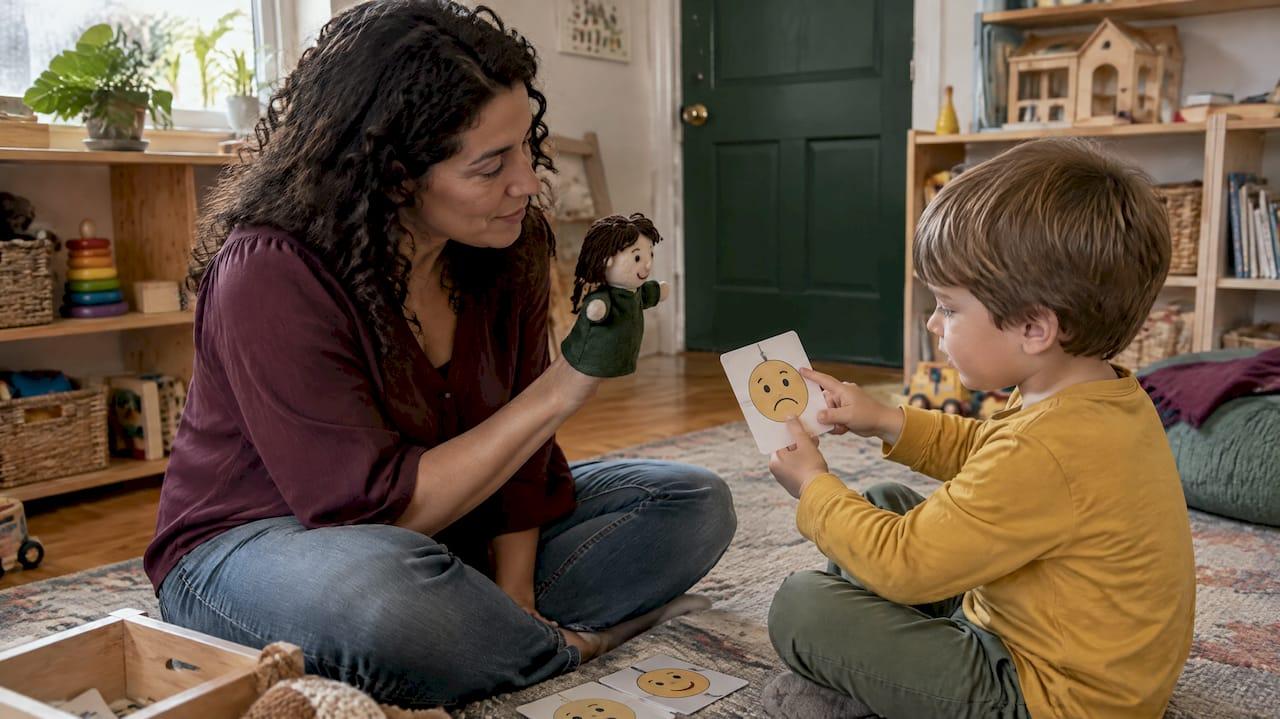
Puppets give children a safe way to talk about feelings. A child who cannot say "I felt left out" can often say "the bunny felt left out." This guide gives you nine puppet activities for ages 3–8, with simple scripts, ways to adjust them for each age, and tips for shy or sensitive kids. You can start with a sock, a paper bag or a popsicle stick.
TL;DR
- Puppets lower the pressure. Children often speak to a puppet more freely than they speak to an adult.
- Start with feeling words (happy, sad, angry, scared), then move to short scenes, songs and problem-solving.
- Keep it light. Five to fifteen minutes is enough for most children ages 3–8.
- Say that all feelings are okay, and help children choose safe ways to show them.
- Never push a shy child to talk. Let the puppet do the talking first.
Table of Contents
- Why puppets work for teaching feelings
- What you need
- Nine puppet activities for feelings
- Adjusting by age and temperament
- What to say while you play
- Our perspective
- Build the habit with Duckwave Decks
- A simple 15-minute puppet session
- FAQ
- Sources
Why puppets work for teaching feelings
Young children feel big emotions before they have the words for them. A puppet gives them a third party to talk through. The child is not the one in trouble, so the conversation feels safer.
The National Association for the Education of Young Children says puppets are a good way to introduce feeling words such as happy, sad and angry. It also notes that children will sometimes talk to puppets about their feelings. Puppets can help with harder topics too, such as getting to bed on time.
There is classroom evidence behind this style of teaching. In a study of Head Start programs, teachers used puppets, stories and games from the Preschool PATHS curriculum to teach children how to make friends and understand and manage feelings. Children who received the combined enhancements showed better emotional understanding and problem-solving. An evaluation of the same curriculum in Head Start CARES found small to moderate improvements in emotion knowledge, social problem-solving and social behavior.
These results come from structured programs. A single puppet game at home will not do the same job. It is still a good, low-cost way to practice the same skills.

What you need
You do not need to buy anything. Pick one of these:
- A sock, with buttons, scrap fabric or yarn for a face
- A paper bag, with markers or crayons
- A popsicle stick with a paper face glued on
- A stuffed animal that already lives in your home
If you want a full step-by-step craft, our guide to making emotion puppets in 20 minutes covers materials and faces. Make at least two puppets so they can talk to each other. Give each one a name. Names make the game feel real.
Also have a few pictures of faces showing different emotions. Drawn faces on index cards work fine.
Nine puppet activities for feelings
1. Name the feeling
Hold up one puppet at a time. Give it a face and a voice. Ask, "How is Pip feeling?" Start with four basic feelings: happy, sad, angry and scared. Add new ones such as proud, nervous or frustrated as the child gets comfortable.
For ages 3–4, use big, clear faces and only two or three feelings. For ages 6–8, add more precise words. Our list of emotion vocabulary for kids by age band shows which words fit which age.
2. One puppet takes a toy
HeadStart.gov suggests acting out situations with puppets. One example is a puppet that takes a toy from another puppet. Then you follow a simple sequence:
- Ask what feeling the puppet might have.
- Let the child pick from pictures of faces showing different emotions.
- Have the child make that face too.
- Ask what the puppet should do next.
The last step matters most. Naming the feeling is half the work. Choosing a next step is the other half.
3. Puppet feelings interview
Sit the puppet on your hand and talk to it in front of the child. Ask, "How are you feeling today? What happened? What would help?" Let the child answer for the puppet if they want to. Many children will.
This works well as a daily check-in. It takes two minutes. Use the same puppet each time so the child learns what to expect.
4. Silly feelings songs
HeadStart.gov recommends making up songs about different emotions to any tune. Its example uses the tune of Row, Row, Row Your Boat. The verses go like "I feel happy when I play outside," and everyone makes a happy face together.
Add a puppet to the song. The puppet sings the first line and the child finishes it. Try "I feel scared when…" and let each child fill in their own ending.
5. Emotion hello
Start the day with a puppet that greets each child by singing a hello song. The child answers by showing a feeling face. The puppet then repeats back what it sees: "You look sleepy today." This builds the habit of noticing feelings every day. It also gives you a quick read on how each child is arriving.
6. Turtle puppet and the shell technique
The Pyramid Model Preschool Classroom Kit includes a turtle puppet and a story that teach four steps called the Turtle Technique:
- Recognize that you feel upset.
- Stop before you take an action.
- Go into your shell.
- Come out when you feel calm or ready.
You can copy the idea with any puppet that has a "hiding spot," like a sock puppet that tucks into a blanket. Let the child practice the steps while the puppet models them. The kit's message is that all emotions are okay, but not all actions are okay. That is a helpful rule to repeat.
7. Puppet role play for tricky moments
Pick one real situation: sharing a toy, losing a game, saying goodbye at drop-off. Let two puppets act it out. First, show the hard version. Then ask the child to help the puppets try another way.
Keep scenes under two minutes. If you want ready-made scripts, our 5 minute role play routines give you printable ones. For a game where the child acts instead of the puppet, see our feelings charades guide.
8. Puppet story time
Read a picture book and let a puppet "react" to it. Pause and ask what the character feels. HeadStart.gov suggests asking, "How can you tell that the character is feeling that way?" and then asking the child to make a face that shows the feeling.
The puppet can ask the questions so the adult does not sound like a quiz. Picking books that hold a five-year-old's attention makes this easier, and our own list of feelings books to read aloud together is organized for ages 3–8.
9. Paper bag puppet mini play
This one suits ages 6–8. A 60-minute lesson plan called Getting Creative with Emotions is written for PreK through elementary. Students look at how emotions show up in faces, body language, voice and color. They make paper bag puppets with a chosen personality, then write a short 10-second dialogue for the puppet in a given situation.
At home, shorten it. Let your child make a puppet, pick a feeling, and perform one short scene. Ten seconds is long enough.
Adjusting by age and temperament
Ages 3–4
Keep it short and physical. Use one puppet, two or three feelings and lots of faces. Let the child hold the puppet, even if they only hug it. Repeat the same game many days in a row. Repetition is how this age learns.
Ages 5–6
Add short stories and two puppets. Ask "what happened first?" and "what could the puppet do?" Children this age often enjoy being the helper who solves the puppet's problem.
Ages 7–8
Move to finer words, such as disappointed, embarrassed or jealous. Let children write or act their own puppet scenes. They can also make a puppet that has two feelings at once, which is a common experience at this age.
Shy or sensitive children
Let the puppet go first, and do not ask the child to perform. Offer choices rather than open questions: "Is Pip feeling worried or sleepy?" Pre-K teacher Holly Van Duyne, in an Edutopia video about the Emotional Ice Cream Shop game, describes helping children choose from several options and modeling what feelings look and sound like. That makes the game reachable for children at any starting point.
A child may also just watch for several sessions. That counts as taking part. If a child seems stuck in strong worry or sadness over weeks, talk to your pediatrician or a school counselor.

Children who communicate differently
Not every child shows feelings with words or faces. Some use gestures, sounds, pictures or movement. Let the puppet respond to any of these. Accept a pointed finger or a drawing as an answer. Our screen-free SEL activities include more options that do not rely on speaking.
What to say while you play
Your words matter as much as the puppet. Three habits help most.
Name the feeling and show you understand. The Pyramid Model kit advises validating, mirroring back and labeling feelings. Its example is "I think you are feeling mad. I would feel mad too if I worked so hard and my tower broke." You can say the same thing through the puppet.
Pair the feeling with a next step. HeadStart.gov gives the example, "It looks like you are feeling mad that we can't go outside; what can we do to help you feel better?" Use it during play and in real moments after.
Praise specific words. HeadStart.gov also says praising children when they use emotion words with friends or teachers reinforces the behavior. Try "You told Sam you were frustrated. That helped him understand."
The Pyramid Model uses the phrase "name it to tame it." Naming a feeling lets a child choose how to respond. Avoid calling feelings good or bad. A puppet can say "I feel angry, and I am not going to hit."
Our perspective
We build stories for children ages 3–8, and we have learned one thing again and again: kids take in feelings best when they are not being lectured about them.
A puppet, a character or a card is a way into the topic that does not feel like a lesson. That is why our work centers on original characters and story worlds. We design them to support emotional literacy without being preachy, and to celebrate each child's individuality.
When you use puppets at home or in class, treat them as characters with their own quirks. A puppet that is a little silly, a little dramatic and always honest invites a child to be honest too. If you also read stories together, you give the puppet more to talk about.
For ideas on how to build a longer routine, see our 6–8 week plan to teach emotions.
Derek Amarillas
Build the habit with Duckwave Decks
Puppet play is easy to repeat when you have prompts on hand. Our Duckwave Decks are themed card decks from the Duckwave Universe, available for $7 one-off. Browse them on the Icon Literary homepage and use them alongside your puppets as conversation starters.

For a wider look at our books, see the Icon Literary catalog, which includes Socko's Universe.
A simple 15-minute puppet session
If you want one plan to follow this week, try this order.
- Greet (2 minutes). The puppet says hello and asks for a feeling face.
- Name (3 minutes). Show two puppets with different faces. Name each feeling.
- Scene (5 minutes). Act out one short situation. Ask what the puppet should do.
- Song or story (3 minutes). Sing a feelings song or read a page of a picture book.
- Close (2 minutes). The puppet says goodbye and names one thing it learned.
Repeat it a few times a week. Change one part at a time so it stays fresh. For a homeschool week of related activities, our homeschool SEL activities are a good next step. Teachers building a preschool routine can read our guide on storytelling for emotional learning.
A fun add-on is a game with emotion charades cards, where the puppet guesses the feeling the child acts out.
Pretend play more broadly also helps children connect feelings with facial expressions, and a short piece on pretend play development shows how this starts in the toddler years.
FAQ
What age is best for puppet emotion activities?
Puppets work across ages 3–8. Younger children need simple faces, a few feelings and a lot of repetition. Older children enjoy writing scenes and exploring mixed feelings. Adjust the length and the words, not the tool.
What if my child will not talk to the puppet?
Do not push. Let the puppet talk to you while the child watches. Offer choices like "worried or tired?" instead of open questions. Many children join in after a few sessions.
Do I need to buy special puppets?
No. A sock, a paper bag or a popsicle stick puppet is enough. Any stuffed animal can also serve as a puppet. What matters is that it has a name, a voice and a face your child can read.
How long should a puppet session last?
Five to fifteen minutes is enough for most children ages 3–8. Short and frequent beats long and rare. Stop while the child is still having fun.
Can puppets help with real behavior problems?
Puppets can help children practice naming feelings and choosing responses. They are a practice tool, not a treatment. If behavior is intense or lasts for weeks, talk with your pediatrician, teacher or a school counselor.
Sources
- Building Social and Emotional Skills at Home, NAEYC
- Everyday Ideas for Increasing Children's Opportunities to Practice Social Skills and Emotional Competencies, HeadStart.gov
- Impact Findings from the Head Start CARES Demonstration, MDRC
- Integrating Preschool SEL with Pre-Academic Skills, CASEL
- The Pyramid Model Preschool Classroom Kit
- Getting Creative with Emotions, lesson plan
- Learning to Name Feelings at the Emotional Ice Cream Shop, Edutopia