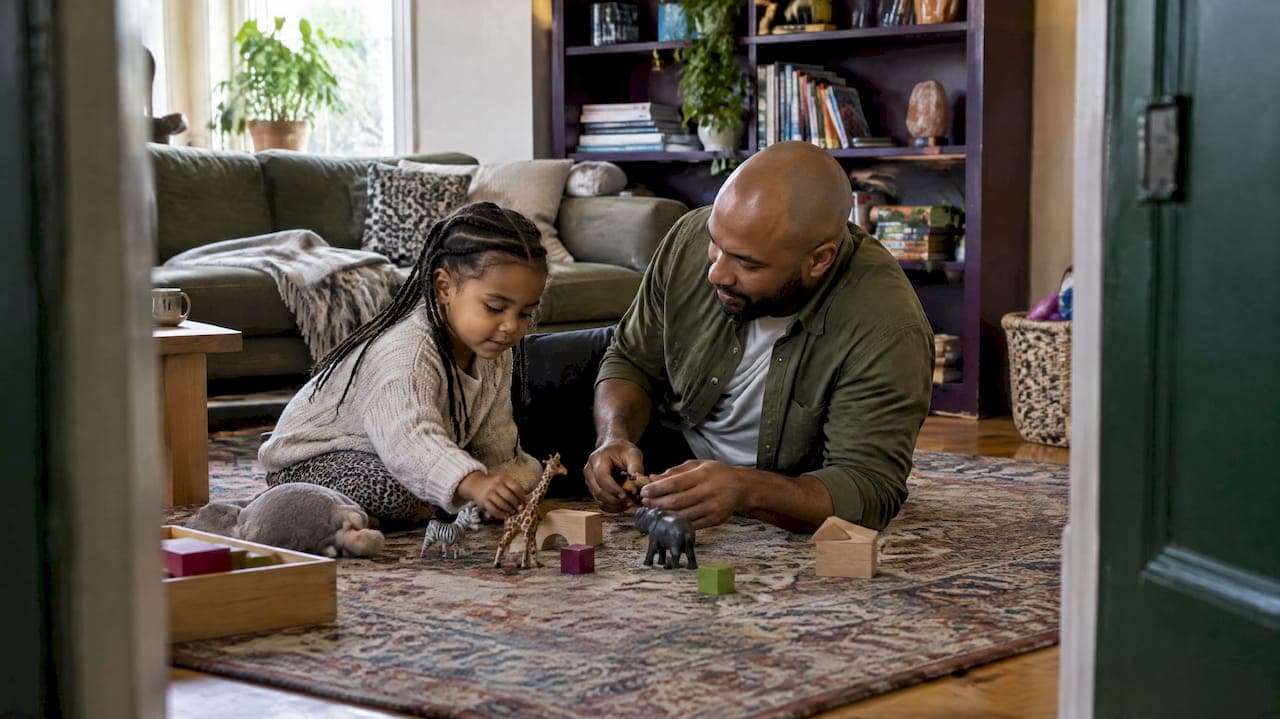
You can bring the core of play therapy into your home, but not by acting as your child's therapist. The version parents can do is a short, uninterrupted, child-led play session, often called special playtime. You follow your child's lead, describe what you see, and stay calm about whatever comes up. Below you will find how a session works, what to say and avoid, activity ideas for ages 3 to 8, and the signs that mean your child needs a professional.
TL;DR
- At-home play therapy means a regular, child-led play session. You are a safe, accepting presence, not a fixer or a teacher.
- A common structure is 30 minutes, once a week, with no phones, no siblings and no agenda.
- Narrate instead of quizzing. Skip questions, instructions and praise or evaluation of what your child makes.
- Home play supports a child's emotional growth. It does not replace a therapist when behavior is persistent, spreads across settings or causes real impairment.
- Feelings books, card decks and simple props give shy or quiet children a way into the play.
Table of Contents
- What play therapy at home actually is
- What the research says
- How to run a home play session
- Therapeutic play ideas for ages 3 to 8
- Our perspective: why story and design matter in therapeutic play
- When home play is not enough
- Tools that make home play easier
- A simple four-week start
- FAQ
- Sources
What play therapy at home actually is
Play therapy rests on a simple idea: young children express themselves through play more easily than through words. In child-centered play therapy, the child makes the choices, and the therapist provides a safe, accepting space, as one child therapy practice explains. Some therapists also teach parents to run "special playtime" at home using the same principles.
That last point is where parents get confused. Many assume home play therapy means they must play the therapist. The research-backed model is different. In Child-Parent Relationship Therapy (CPRT), an adaptation of child-centered play therapy for parents of children ages 2 to 10, parents learn to become the therapeutic agent through a special 30-minute, child-led session. The goal is a secure connection in which your child feels safe enough to show their inner world through toys. The goal is not to correct behavior in the moment.
A related approach is filial therapy. A parent handout from a counseling practice describes it as learning a specific way of playing with your child, with your attention undivided and focused on them.
Why parents are a good fit for this
Parents are not a second-best substitute for professionals here. A National Academies chapter on behavioral health describes parents as a critical emerging workforce. Professionals handle clinical care, and parents can partner with them to give steady, family-driven support at home. That matters most for younger children who are still building language, because play lets them say what they cannot yet put into words.
What the research says
A 2024 meta-analysis of 25 studies looked at child-centered play therapy and CPRT for children ages 3 to 13 with internalizing problems such as anxiety, depression and withdrawal. It found significant effect sizes, from small to large, for reducing those symptoms. Note what was studied: structured programs, usually with trained guidance. A few good ideas from a blog post are not the same thing, so treat this article as a starting point, not a treatment plan.
How to run a home play session
The structure does most of the work. Practitioners suggest that a set routine, such as 30 minutes once a week, helps contain the emotional energy for both child and parent. Parents are often surprised by how intense a session can feel, and a clear start and end keeps it manageable.
Set up the space
- Pick a spot and a time. A corner of the living room or a bedroom floor works. Choose a time when you will not be interrupted, and put your phone out of reach.
- Choose simple toys. Think a doll family, animal figures, a few cars, art supplies, a puppet, a toy phone, blocks. Open-ended toys beat toys that do one thing. If you want a permanent spot, our guide to designing a feelings corner kids actually use covers layout and what to keep in it.
- Tell your child what this time is. For example: "This is your special playtime. You can choose what we do, almost anything." Mention the time limit once at the start and give a short warning before the end.
- Keep the same time each week. Predictability helps children relax into the play.
During the session
Your job is to stay present. Use these moves:
- Describe what you see. "You're putting the horse in the barn." "That car is going fast."
- Reflect feelings you notice. "That seems frustrating." "You look proud of that tower."
- Let your child lead. If they want you to be the villain, ask them how the villain should sound, or follow their direction.
- Hold the limits. Safety and respect for property still apply. State a limit calmly and briefly, and offer another choice.
What to avoid
The most common pitfall is turning playtime into a lesson. Practitioners advise parents to avoid asking questions, giving instructions, or praising and evaluating what the child creates, because it protects the child's sense of agency. Parents are often surprised that simply narrating, without judgment, works better than trying to guide.
| Instead of | Try |
|---|---|
| "What is that you drew?" | "You used a lot of blue." |
| "Good job!" | "You worked hard on that." (or just describe it) |
| "Why is the bear so angry?" | "The bear looks really angry." |
| "Let's put the toys away nicely." | "You decide where the dinosaurs go." |
| "Don't hit the doll." (as a lesson) | Stay calm. Only step in if safety is at risk, and state the limit simply. |
Expect big moments
A child may act out a scary scene, repeat the same game for weeks, or get upset when time is up. Repetition is normal in play. Your steady, accepting presence is the point. Afterward, take a minute for yourself. If a session left you shaken, that is a good thing to share with a pediatrician or therapist.
Therapeutic play ideas for ages 3 to 8
The child-led session is the foundation. Once the habit is in place, you can add structured activities at other times of the week. These are more like emotional-literacy practice than therapy, and they work well alongside it. Keep them light.
Ages 3 to 4: pretend and name
- Imagination play with a stuffed animal. Propose a simple story, such as the doll going out for a bike ride, and let your child steer where it goes.
- Feelings faces. Make faces in a mirror together and name them. Our guide to emotion vocabulary for kids in three age bands has scripts you can use today.
- Read aloud, slowly. Stop on a character's face and wonder about it. See our guide to reading feelings books together for ages 3 to 8.
Ages 5 to 6: games with feelings in them
- Feelings ball toss. Write a feeling on each side of a ball and toss it back and forth, as one list of play therapy techniques suggests. Take turns sharing a time you felt it.
- Charades. Acting out emotions without words suits kids who clam up when asked to talk. Try our 10 to 20 minute feelings charades.
- Sorting games. Group pictures or objects by feeling. We have low-prep emotion sorting activities that take about 10 minutes to set up.
Ages 7 to 8: stories, rating and reflection
- Make a comic or story together. Let your child write the ending for a character who has a hard day.
- A 1 to 10 feelings rating. It gives older kids a quick, low-pressure way to say how big a feeling is. See family empathy activities that start small.
- Card decks. Draw a card, name the feeling, and talk about the character instead of yourself. Distance often makes it easier to open up.
Model your own feelings
The American Academy of Pediatrics says children build emotional literacy when parents consistently help them label their own emotions. One way: name when you are in the yellow zone (anxious or agitated) and describe the steps you take to get back to the green zone (calm and focused). Your child gets to watch the process. For more on this approach, see our five steps of emotion coaching with scripts by age.
Our perspective: why story and design matter in therapeutic play
At Icon Literary, we make picture books, themed card decks and activity kits for children ages 3 to 8. We are a creative studio, not a clinic, and we do not claim our products are therapy. What we do know is how a child responds to a character.
We design our stories to approach emotional literacy without lecturing. A child who feels taught will often shut down, and a child who feels invited will lean in. That mirrors the rule of child-led play: no quizzing, no moral at the end. Characters like the ones in our Duckwave and Socko worlds can carry a feeling so the child does not have to carry it alone. A sensitive or shy child can say "the duck is nervous" long before they can say "I'm nervous."
Our advice to parents is simple. Use stories and cards as props for the play, not as the lesson. Let your child pick the card, ignore the card, or turn it into a game of their own. If it opens a door, walk through it by describing what you see. If it does not, put it away and try again next week.
— Derek Amarillas
When home play is not enough
Home play is a good complement, but it has limits. Practitioners generally advise that if a child cannot manage their behavior independently, individual play therapy with a trained professional is preferred over a family-led session.
Typical or dysregulated?
Lots of difficult behavior is just development. Dr. Laura Dimler notes that high energy, moving between tasks and interrupting are developmentally typical for 5-year-olds. Behavior is considered atypical when it is persistent, shows up across multiple settings, and causes significant impairment compared with same-age peers. If that sounds like your child, talk to your pediatrician.

A pediatric consulting practice describes dysregulation as difficulty managing emotional, behavioral or physiological responses. Signs can include big meltdowns over small things, extreme sensitivity to sensory input, frequent outbursts, or constant movement that interferes with daily life. It is not simply bad behavior.
Who to call
- Your child's pediatrician, first, for a general check and a referral.
- A licensed child therapist or play therapist, for anxiety, withdrawal, big changes, loss or trauma.
- A school counselor, if the trouble shows up mostly at school.
- A pediatric occupational therapist, if sensory needs seem to drive the meltdowns.
If your child talks about harming themselves or others, or you are worried about their safety, contact your pediatrician or local emergency services right away.
What therapy costs
Cost keeps many families from starting. One 2026 overview reports that outpatient mental health sessions for children average $100 to $200, with $200 to $350 or more in major cities. The same source says many insurance plans cover psychotherapy when it is medically necessary, and that sliding-scale options can bring sessions down to $20 to $100. Call your insurer and ask about child mental health benefits before you book.

Tools that make home play easier
A few good props lower the barrier for kids who do not know what to do with open play. Our Duckwave Decks are themed card decks you can use as a prop in a feelings game, a charades round or a quiet card-by-card chat. They are $7, one-off, at Icon Literary. If your child likes to follow a character through a longer world, browse Socko's Universe in our catalog.
Shopping for a relative or a classroom? Our list of gifts that support child emotional growth has eight picks. If you teach at home, our 12 homeschool SEL activities fit around a normal school day. For a longer arc, there is a 6 to 8 week plan to teach emotions to kids.
A simple four-week start
- Week 1: Set up the space and run a 30-minute session. Only describe what you see. Do not worry about getting it perfect.
- Week 2: Same time, same place. Notice what your child returns to, and keep your reactions calm.
- Week 3: Add one feelings activity outside the session, like a read-aloud or a charades round.
- Week 4: Look back. Is your child more willing to name a feeling? Are you more relaxed? If worries have grown, call your pediatrician.
There is no scorecard. Show up on time and stay curious.
FAQ
Do parents sit in on play therapy?
It depends on the therapist and the model. In individual child-centered play therapy, the child often meets with the therapist alone. In parent-involved models such as CPRT and filial therapy, the therapist coaches the parent to run the sessions at home. Ask any therapist you are considering how they involve parents.
Can I do play therapy at home without training?
You can do child-led special playtime without being a therapist, and many parents find it helpful. Keep it simple: describe, reflect feelings, hold safety limits and avoid questions or praise. If your child's struggles are serious, a trained professional should lead, with you supporting at home.
How long and how often should home sessions be?
A common structure is 30 minutes once a week, with no interruptions. A set time and length also helps you cope with strong feelings that may come up. If weekly is too much for your family, a shorter session at the same time every week is better than an irregular long one.
How do I know if my 5-year-old is dysregulated?
Look for patterns that last, show up in several settings and interfere with daily life. Examples include huge meltdowns over small things, strong sensory reactions or constant outbursts. Energy and interrupting alone are common at age 5. If you are unsure, ask your pediatrician.
Sources
- Child-Parent Relationship Therapy, program profile
- Filial Play Therapy handout for parents
- What is Child-Centered Play Therapy and how can it help my family?
- 4 Play Activities to Help Children Manage Emotions, HealthyChildren.org
- Impact of CCPT and CPRT on internalizing behaviors: a meta-analysis
- Behavioral health workforce chapter, National Academies
- Ask the MD and PhD: milestones and meltdowns
- Understanding Dysregulation: A Guide for Parents
- Does Insurance Cover Play Therapy? Billing, Medicaid, and Costs
- In-Home Play Therapy